
GLOBAL SURGERY 101
What Is Global Surgery?
Global surgery is the multidisciplinary field of study, research, practice and advocacy that seeks to improve health outcomes and achieve health equity for everyone who needs surgical, obstetric, trauma and anaesthesia care.
BEYOND THE OPERATING ROOM
Surgery is more than an operation.
It is a health system.
Whether someone survives an injury, receives a safe Caesarean section, undergoes cancer surgery or regains sight after cataract treatment depends on far more than the availability of a surgeon.
Surgical care depends on trained teams, anaesthesia, nursing, blood, oxygen, sterile equipment, diagnostics, medicines, functioning infrastructure, transport and referral networks, rehabilitation, financing, data and effective governance.
Global surgery studies and strengthens this entire ecosystem, with particular attention to people and communities that are underserved by existing health systems.
A MULTIDISCIPLINARY FIELD
Global surgery is not just surgery.
The field sits at the intersection of clinical care, public health, engineering, economics, policy and health systems.

Surgery · Anaesthesia · Obstetrics · Nursing · Emergency Care · Rehabilitation · Biomedical Engineering · Public Health · Health Policy · Economics & Financing · Data & Research · Supply Chains · Infrastructure · Transport & Referral · Energy & Oxygen
THE FIELD AT A GLANCE
What defines global surgery?
Multidisciplinary
Surgical systems depend on collaboration across clinical, public-health, engineering, economic and policy disciplines.
Intersectoral
Progress requires more than the health sector. Education, infrastructure, finance, transport, energy and data systems all shape access to care.
Equity-focused
Global surgery asks who is being left behind and seeks to reduce inequities within and between communities and health systems.
Systems-oriented
Access, workforce, safety, quality, infrastructure and financial protection are treated as interconnected parts of one system.
MYTHS & MISCONCEPTIONS
What global surgery is — and what it isn’t.
Myth 1: Global surgery is only about surgeons and operations.
REALITY
Global surgery encompasses the entire surgical ecosystem. Anaesthesia professionals, nurses, obstetricians, engineers, rehabilitation professionals, public-health specialists, economists, researchers, policymakers and many others are essential to making surgical care possible.
Myth 2: Surgery is too expensive to be a global-health priority.
REALITY
Many essential surgical interventions are highly cost-effective. Untreated surgical disease also creates enormous costs through preventable death, disability, lost productivity and catastrophic household expenditure.
Myth 3: Global surgery means flying foreign doctors somewhere to operate.
REALITY
Modern global surgery prioritizes locally led, sustainable capacity, equitable partnerships and long-term health-system strengthening. Short-term clinical activity is not a substitute for durable systems.
Myth 4: Global surgery is mainly about emergency surgery.
REALITY
Emergency surgery saves lives, but surgical systems also manage cancer, congenital conditions, cataracts, hernias, musculoskeletal disease, complications of non-communicable diseases and many other non-emergency conditions.
Myth 5: Building more hospitals will automatically solve the problem.
REALITY
A facility alone does not guarantee access. Patients must be able to seek care, reach the facility in time, receive safe treatment and continue through postoperative care and rehabilitation without facing unacceptable financial barriers.
Myth 6: Training more surgeons alone will fix surgical access.
REALITY
A surgeon cannot operate safely without anaesthesia, nursing, blood, oxygen, diagnostics, sterile instruments, reliable infrastructure and postoperative care. Workforce expansion must occur alongside broader system strengthening.
UNDERSTANDING ACCESS
Having a hospital nearby does not necessarily mean having access to surgery.
A patient must successfully move through an entire pathway of care. A failure at any point can turn a treatable condition into death, disability or financial hardship.
NEED
SEEK
REACH
RECEIVE
REMAIN & RECOVER
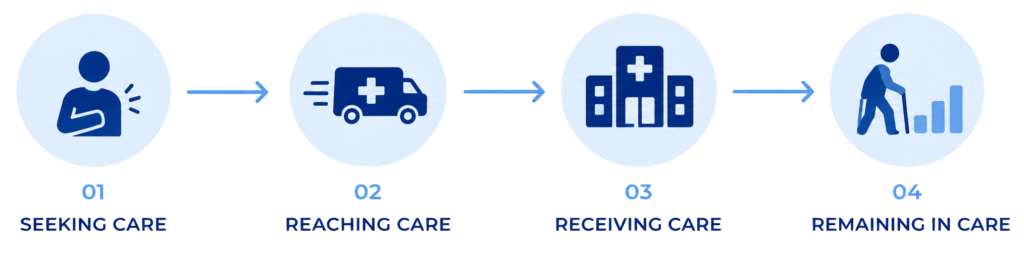
The Four Delays
01
Seeking Care
Knowledge, social, cultural and financial barriers may prevent someone from seeking care when it is needed.
02
Reaching Care
Geography, roads, transport, conflict and referral failures can prevent patients from reaching an appropriate facility in time.
03
Receiving Care
Patients may arrive at a hospital but face delays because of workforce shortages, unavailable theatres, medicines, equipment, blood or oxygen.
04
Remaining in Care
Safe surgery continues after the operation. Follow-up, medicines, rehabilitation, transport and affordability all influence recovery.
MEASURING SYSTEM CAPACITY
The Bellwether Procedures
Three procedures are commonly used as indicators of whether a health system has the capacity to provide essential surgical care.
Caesarean Section
Represents the capacity to respond to life-threatening maternal and neonatal complications.

Emergency Laparotomy
Represents the capacity to treat major abdominal surgical conditions such as obstruction or perforation.

Open Fracture Management
Represents essential trauma capability, including stabilization, infection prevention & operative management.

A facility capable of safely performing these procedures is likely to possess many of the systems required for broader surgical care: trained teams, anaesthesia, sterile technique, blood, equipment and postoperative care.
Building this capacity also strengthens care for non-emergency conditions, including cancer, chronic disease and disability.
UNIVERSAL HEALTH COVERAGE
Surgery is not a luxury.
Essential surgical and anaesthesia care is an integral component of a functioning health system and universal health coverage.
Universal health coverage cannot be universal if people cannot access the surgical care they need.
SYSTEMS THINKING
From the operating room to the health system.
Safe surgery is the visible result of many systems working together.
PATIENT & COMMUNITY
Health needs · Trust · Health literacy · Affordability · Access
CLINICAL TEAM
Surgery · Anaesthesia · Obstetrics · Nursing · Allied Health · Rehabilitation
FACILITY
Operating Theatres · Sterilisation · Oxygen · Blood · Diagnostics · ICU · Equipment
HEALTH SYSTEM
Workforce · Procurement · Referral · Transport · Data · Financing · Quality · Governance
SOCIETY
Education · Infrastructure · Economy · Government · Communities · Equity
HOW WE GOT HERE
A brief history of global surgery.
1980 — The inequity is named
WHO Director-General Halfdan Mahler draws international attention to the profound global inequity in access to skilled surgical care and surgical resources.
2008 — The “neglected stepchild” of global health
Growing academic and public-health attention challenges the longstanding exclusion of surgery from mainstream global-health priorities.
2014 — Defining the field
Academic work helps formalize global surgery as a field of study, research, practice and advocacy focused on improving health outcomes and achieving health equity.
2015 — Global Surgery 2030
The Lancet Commission on Global Surgery provides landmark evidence on surgical access, workforce, volume, safety and financial protection and proposes measurable targets for 2030.
2015 — WHA Resolution 68.15
WHO Member States formally recognize emergency and essential surgical care and anaesthesia as a component of universal health coverage.
2016–2022 — From evidence to implementation
Countries, academic networks and civil-society organizations increasingly translate global frameworks into national surgical planning, research, education and advocacy.
2023 — Emergency, Critical & Operative Care
WHA Resolution 76.2 strengthens the place of integrated emergency, critical and operative care within health systems, universal health coverage and emergency preparedness.
2025–2035 — The next decade
The global surgery agenda increasingly moves from recognition toward implementation: sustainable financing, workforce, resilient infrastructure, supply chains, data and integration into national health systems.
2026 — A global strategy for integrated ECO care
WHO Member States adopt a global strategy for integrated emergency, critical and operative care, reinforcing the importance of these services across health systems.
MAKING THE CASE
Why does global surgery matter?
01
The Health Case
Surgical conditions contribute substantially to global death and disability. Surgical capacity is essential across maternal health, trauma, cancer, congenital conditions, non-communicable diseases and emergency care.
02
The Economic Case
Untreated surgical disease removes people from education and employment, reduces productivity and can push households into poverty. Investing in surgical systems is an investment in health and development.
03
The Equity Case
Geography, income, gender, infrastructure and social conditions influence whether people can obtain surgical care. Global surgery seeks to ensure that need — not privilege — determines access.
04
The Health-System Case
Surgical systems depend on oxygen, blood, diagnostics, critical care, workforce, supply chains and referral networks. Strengthening these capacities can strengthen the wider health system and its ability to respond to crises.
FROM ADVOCACY TO ACCOUNTABILITY
How do we measure progress?
Global surgery is measurable. Health systems can use common indicators to identify gaps, establish priorities and track progress.
Access to Timely Essential Surgery
Can people reach a facility capable of providing essential surgical care within an appropriate period of time?
Surgical Workforce Density
Does the population have adequate access to trained surgical, anaesthesia and obstetric professionals?
Surgical Volume
Is the health system delivering enough surgical procedures to meet population need?
Perioperative Mortality
Are surgical services being delivered safely, and are outcomes being systematically measured?
Financial Risk Protection
Can people obtain necessary surgical care without being pushed into poverty or facing catastrophic health expenditure?
A GLOBAL FIELD
“Global” does not mean “somewhere else.”
GLOBAL ≠ ABROAD
Global surgery is not defined by crossing a border, travelling to another country or working only in low-resource settings.
Surgical inequity can exist anywhere. Rural access, workforce shortages, waiting times, financial barriers, fragmented referral systems, conflict, disasters and unequal outcomes can affect communities in countries at every income level.
What makes global surgery global is its commitment to equity, systems thinking, shared learning and universal access — while recognizing that the nature and severity of barriers differ dramatically between contexts.
AN IMPORTANT DISTINCTION
Global surgery is broader than any one model of delivering care.
Global Surgery ≠ International Surgery
International collaboration may form part of global surgery, but crossing national borders is not what defines the field.
Global Surgery ≠ Humanitarian Surgery
Humanitarian surgical care can be vital during crises, but global surgery also addresses routine health systems, national policy, education, financing, research and long-term capacity.
Global Surgery ≠ Surgical Missions
Short-term missions may provide services in particular circumstances, but sustainable global surgery emphasizes local leadership, continuity, accountability and system strengthening.
Global Surgery ≠ Surgery in LMICs
Many of the world’s greatest surgical-access gaps occur in low- and middle-income countries, but global surgery examines inequity and surgical systems in every region of the world.
A PLACE FOR EVERY DISCIPLINE
Who belongs in global surgery?
Anyone whose work influences whether a patient can obtain safe, timely and affordable surgical care can contribute to the field.
Surgeons · Anaesthesia Professionals · Obstetricians · Nurses · Midwives · Emergency-Care Professionals · Rehabilitation Professionals · Biomedical Engineers · Public-Health Professionals · Epidemiologists · Economists · Health-Financing Specialists · Data Scientists · Researchers · Supply-Chain Specialists · Policymakers · Advocates · Communicators · Patients & Communities
THE QUESTION AT THE HEART OF THE FIELD
How do we build surgical systems that allow every person who needs surgical care to receive it safely, in time, and without financial hardship?
Answering that question requires clinicians, communities, governments, researchers, engineers, economists, advocates and the next generation of health-system leaders to work together.
FROM UNDERSTANDING TO ACTION
Global surgery is a field.
InciSioN is part of the movement.
Across our global network, students, trainees and early-career professionals turn global-surgery principles into education, research and advocacy — locally, nationally and globally.