
INciSioN GLOBAL / UNIVERSAL HEALTH COVERAGE
SUSTAINABLE HEALTH FINANCING · SURGICAL FINANCIAL PROTECTION
Sustainable financing is essential to surgical access.
A procedure can be clinically available yet financially inaccessible. Health financing shapes who reaches care, what services function reliably and whether treatment exposes families to devastating costs.
As the 2027 UN High-Level Meeting on UHC approaches, the task is to connect public commitments with budgets, accountable delivery and financial protection across the full surgical care pathway.
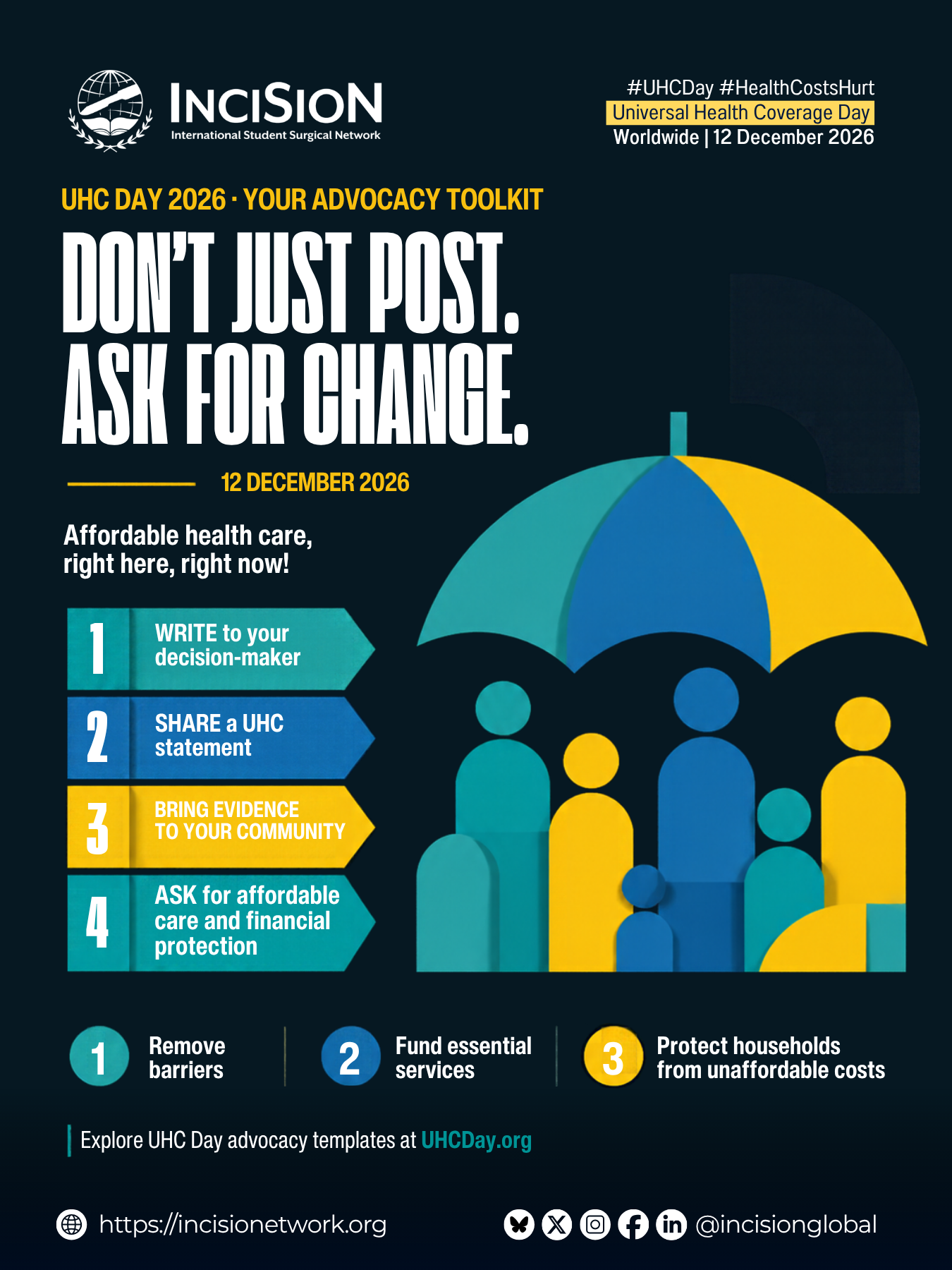
UHC Day 2026 · Advocacy and financing as part of health systems reform
How money is raised, pooled
and spent determines access.
Health financing is not just a budget line or an insurance card. Public revenues, risk pooling, provider payments and accountability all influence whether essential services can be delivered without transferring unaffordable costs to patients.
Revenue raising
Where funds originate, including public budgets and other sustainable sources.
Surgery example: financing reliable emergency surgical capacity.
Pooling
Spreading financial risk so illness does not leave an individual household bearing the whole cost.
Surgery example: covering essential obstetric and surgical care.
Purchasing
How funds pay providers and services, shaping incentives, quality and service readiness.
Surgery example: paying facilities for full care pathways, not just procedures.
Accountability
Whether allocated resources reach services, are used transparently and produce equitable benefits.
Surgery example: monitoring medicine stock-outs and patient charges.
Measure what patients actually bear.
Out-of-pocket (OOP) spending
Direct payments households make for health services at the point of use. The OOP share of national health expenditure is not the percentage of families facing catastrophic spending.
Catastrophic health expenditure
Health payments exceeding a specified share of household resources. Common thresholds differ—such as 10% of total consumption or 40% of non-food expenditure—so definitions must accompany estimates.
Impoverishing health expenditure
Health payments that push households below, or further below, a stated poverty threshold. Estimates depend on the poverty line and measurement period.
Forgone care
Needed treatment not sought or received because of costs or other barriers. Hospital-based studies may miss people who never reach a facility or who cannot undergo surgery.
A “free operation” can still be unaffordable.
Patients may face costs before admission, during treatment and long after discharge. What matters is the total household burden—not just the formal surgical fee.
These are possible cost components, not universal charges. Non-medical costs and lost income must not be mislabelled as direct medical OOP expenditure.
Financial hardship is measurable.
Interpret the figures carefully.
Research consistently identifies financial risk in surgical care, but data differ by country, procedure, population and expenditure threshold. The examples below deliberately distinguish historical modelling from patient-level observation and indicator reviews.
Historical global modelling
Shrime and colleagues (2015) modelled 81.3 million people annually at risk of catastrophic expenditure due to surgical conditions, including medical and non-medical costs. This is not an observed 2026 total.
Hospital surgical patient sample
In a multicentre Ethiopian study, 103 of 412 surgical patients experienced catastrophic expenditure under the authors’ definition. This is not a national population prevalence estimate.
Countries with national reporting in reviewed evidence
A 2026 review of surgical financial-risk indicators found national reporting in only five countries in the evidence assessed. The finding is about limited measurement and uneven reporting.
What does the wider literature add?
These studies inform advocacy but do not identify one financing mechanism that works everywhere. Their designs and settings matter.
Emergency abdominal surgery · Ethiopia (2022)
Genetu et al. studied out-of-pocket costs and catastrophic expenditure in a 142-patient hospital sample. Associations with insurance are observational.
Financing surgery in low-resource settings (2025)
Mengistie et al. reviewed revenue raising, pooling, purchasing and policy approaches in a narrative synthesis, not a causal effectiveness trial.
Government-led “free” Caesarean policies (2025)
Adepoju et al. assessed policy reforms and uncovered residual fees and implementation constraints alongside evidence of increased service use.
Surgical financial hardship across LMIC studies (2024)
Klazura et al. synthesised research with varied definitions and methods; these differences limit simple pooling and global extrapolation.
Financial protection policies across LMICs (2026)
Kruja et al. reviewed diverse financial protection interventions. Outcomes were context-sensitive and did not support a universal single solution.
Six questions for financing policies
that deliver surgical care.
Use these lenses to interrogate a national policy and build feasible asks. They are InciSioN’s analytical questions, not a purported WHO-approved policy checklist.
Who receives the funding?
Are essential surgical and obstetric services financed, and do rural and low-income communities benefit?
What costs remain?
Do patients still pay for medicines, tests or supplies despite apparent benefits or insurance coverage?
How are providers paid?
Do reimbursement systems sustain quality, emergency readiness and continuity of care without perverse incentives?
Who bears indirect burdens?
Are travel, lodging, caregiving, rehabilitation and income loss considered when designing protection?
Can we track patient hardship?
Are actual charges, denied care, budget execution and financial harm visible without violating privacy?
Are plans funded?
Do surgical, obstetric and anaesthesia priorities connect to medium-term budgets and UHC implementation?
Health financing is a political commitment.
WHA78.12 (2025), Strengthening health financing globally, calls attention to resilient financing, public resources, pooling, reduced out-of-pocket payments, sound financial management and accountability.
WHA77.2 (2024) on social participation highlights the importance of meaningful community involvement. That principle applies to decisions about health budgets and service priorities.
Budgets only matter when they become accessible services.
The challenge is not just whether a financing commitment exists, but whether the intended funds, services and protections reach people.
Official text: World Health Assembly, 27 May 2025. This is InciSioN’s editorial interpretation of the policy relevance.
The September 2027 UN High-Level
Meeting on Universal Health Coverage.
The UN will hold a one-day UHC High-Level Meeting at UN Headquarters in New York in September 2027, during the General Assembly. Its theme is “Universal health coverage: accessible and affordable health for all by 2030.” The exact date had not been announced as of 28 October 2026.
ASSESS & CONNECT
Review national UHC commitments and indicators; identify affected communities and partners.
DEVELOP YOUR ASKS
Draft country-specific, evidence-led messages and follow consultation arrangements.
MULTI-STAKEHOLDER HEARING
Monitor official procedures and submit evidence through eligible channels where possible.
TRACK THE DRAFT
Follow negotiations and engage relevant advocacy coalitions.
UN HIGH-LEVEL MEETING
Advocate for accessible, affordable services and financial protection for essential surgery.
FOLLOW IMPLEMENTATION
Compare commitments with budgets, coverage decisions and patient experiences.
This is a suggested preparation sequence, not a schedule of confirmed InciSioN activities.
Choose one problem. Build one credible ask.
For National Working Groups, students, clinicians and civil society advocates, a strong advocacy cycle links data to experience and decision-making—not merely to social-media posting.
EXPLORE
Open the ACT dashboard. Record one relevant indicator, its year, definition and source.
CHECK REALITY
Listen to people experiencing charges or forgone care, with consent and appropriate safeguards.
DEFINE THE GAP
Is the problem budget execution, indirect costs, benefit design, medicine charges or unequal access?
MAP CONTACTS
Identify three to five organizations, providers, patient advocates or decision-makers able to act.
MAKE THE ASK
Request one feasible, measurable action that addresses the identified gap.
FOLLOW UP
Use an advocacy letter or statement; document responses and revisit the commitment.

Continue learning with Voices for UHC
Join the WhatsApp community for shared youth advocacy opportunities and discussions, while following its rules and respecting participants’ privacy.
Does health insurance automatically prevent catastrophic spending?
No. Coverage rules, user payments, unavailable medicines, transport and other costs can leave households exposed. Compare entitlements with actual patient costs.
Is the 2015 estimate of 81.3 million a current global count?
No. It is a historical modelled estimate under specified assumptions, not a measurement of households in 2026.
How can youth advocates participate in the 2027 HLM process?
Follow UHC2030 and official UN channels for the multi-stakeholder hearing and consultation procedures. Participation is subject to the applicable rules and does not guarantee accreditation or a speaking invitation.